
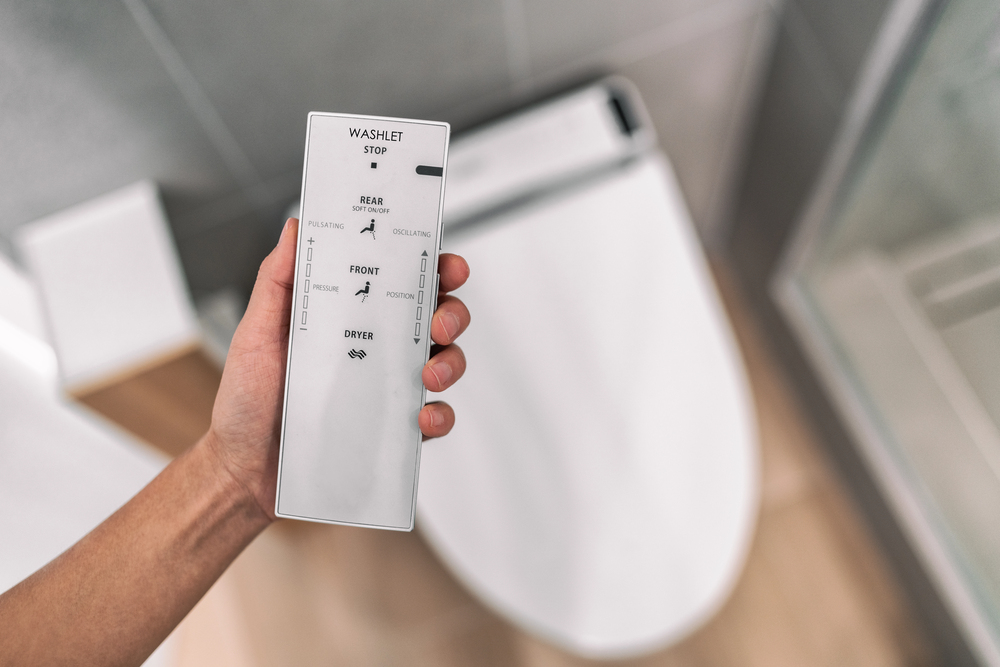
Alongside a multitude of house appliances, toilets were not immune to the technological advances of recent years. Although still considered a long-term appliance, which mostly gets replaced in cases of plumbing issues and radical house makeovers, the industry has been fighting back to include toilets in the long list of futuristic white goods. Enter the smart toilets, an initially asian trend that has been harnessing both curiosity and interest in the Western public.
What exactly are smart toilets?
In simple words, toilet with built-in responsive technology were created in the 80’s Japan to revolutionise the time spent in the bathroom. Back then technologies still foreign to the average Western individual were created, such as heated seats, bidet spray, warm air dryer and deodorizer.
Those features focused on the user comfort, envisioning a time spent in the bathroom as pleasant and comfortable as possible. Other features, more known by western citizens, such as auto-lid and auto-flush were also developed around that time. Unlike the more intricate technologies, both auto-lids and auto-flushes were massively incorporated in several shopping malls and public spaces.
The latest innovations pioneered by Japan have only improved and complemented the concept idealised in the 80’s: toilets that are not only comfortable and pleasant, but that combine the latest technologies to turn the bathroom time into a time of self-care and relaxation, catering for both the psychological and physical aspects of the user. They focus on luxury, hygiene, environmental efficiency, and health insights.
Here are some of the most interesting, groundbreaking features of the latest Smart Toilets:
- Health Monitoring & AI‑Driven Analysis
Some cutting-edge Smart Toilet models include a stool scanner, which analyzes stool shape, colour, volume, and frequency. Linked to an app, they can provide recommendations on diet and exercise catered to your physiological needs. Some of the latest models can even analyse biomarkers in urine and stool to detect signs of dehydration, diabetes, kidney function, and possibly even cancer, providing health dashboards and alerts. Future models are expected to be able to monitor glucose, protein, or blood levels for medical diagnostics.
While these technologies are undoubtedly groundbreaking and invaluable for medical purposes, and may well change the future of healthcare, they are still unaccessible to the largest portion of the population, given their hefty price tag. It’s estimated that a smart toilet equipped with the newest stool analyzing sensors from Toto Nearests starts at approximately $4.280.
- Enhanced comfort and Hygiene
The latest smart toilets have several tools aimed at providing advanced comfort and hygiene. Besides heated seats perfect for cold mornings, there are various settings to improve general hygiene by allowing you to adjust temperature, pressure and spray type in the bidet. Warm air dryers are built-in to maximise a soothing cleaning experience. The bidet cleansing reduces the absolute need of toilet paper, providing cleaner and more hygienic results.
Focused on the general well-being and positive user experience, they also come with deodorizers and ambient lighting. Some of them can even be linked to Amazon Alexa, having a Bluetooth connection and app control. The Alexa connected speakers besides offering the possibility of voice controlling features, are a natural evolution to the early “otohime” system, also known as “princess of sound”, which were speakers designed to drown out any unpleasant user noise.
The combination of those features aimed to enhance user comfort result in a soothing spa-like experience coveted by both the elites and the average working class man.
- Self-cleaning features
Another favourite feature of modern smart toilets is their self-cleaning abilities. It exponentially reduces the need for manual maintenance, which tends to be one of the least favourite activities of modern homeowners. This is only possible given a combination of technologies in the high end models: use of electrolyzed water (slightly acidic or basic water with antimicrobial properties) and/or UV light to sanitize the nozzle.The more affordable models count with a bidet system that rinses the device before and after each use.
The advantages of the self-cleaning features are not limited to the time saved by the user, but they excell in protecting them from direct contact with bacteria, consequently reducing microbial contamination and virus and infection spread.
- Eco-friendly system

Modern smart toilets are a significant technological advance for the preservation of the environment, as many were designed specifically with the intention of reducing waste of water and usage of toilet paper.
The dual-flush technology or pressure-assisted flushing system existent in many smart toilets are responsible for drastically reducing the amount of water needed for a efficient cleanse of the toilet after usage. While a normal toilet uses between 3 to 5 gallons of water per flush, smart toilets with those technologies reduce those numbers to between 0.8 and 1.28 gallons per flush. This means a single household could potentially save thousands of gallons of water per year, just by switching to a smart toilet.
The substitution of toilet paper is another great reason to invest on a smart toilet. With a supply chain marked by deflorestation, excessive water wasting and chemical pollution, the mass use of toilet paper highly affects the environment in diverse ways. Smart toilets may be just the right choice for those willing to opt out of this surprisingly unsustainable practice.
Self cleaning features also prove to have a positive impact on the environment, as it drastically reduces the amount of chemical products the user will need to clean the toilet.
While smart toilets may still be a luxury for few, they also represent a promise for the future. More and more companies are developing their own versions of the appliance, and a market before restricted to Japan has become increasingly internationalised. The smart toilet costumer base is rapidly growing, and nowadays it is possible to buy them in the United States, United Kingdom and Europe. Some of the main brands for smart toilets are TOTO (e.g., Neorest series), Kohler (e.g., Numi 2.0), Brondell, BioBidet, Alpha Bidet and SmartBidet.